Teardown by Connor Graham 🙂
Executive Summary
Monopoly Go! has proven itself as a dominant force in the mobile gaming landscape, boasting over $3 billion in revenue since its launch in April 2023. Its offers a simple yet rewarding core game loop, an engaging meta loop, and very simple yet effective monetization strategies. The game has some standout features that include tons of limited-time modes (LTMs), social and friend interactivity, and the immersive use of haptic feedback. Players are continually incentivized through innovative systems that turn setbacks into opportunities and reward collaborative play. Now, let’s dive into why Monopoly Go performs so well, and a few recommendations I’d like to see.
Table of Contents
- About Monopoly Go!
- FTUE
- Core Game Loop & Meta Loop
- Economy
- What Monopoly Go does Great
- Recommendations
- Conclusion
About Monopoly Go!
Title: Monopoly Go!
Genre: Board Game
Subgenre: Social Casino
Developer: Scopely, Inc.
Worldwide Release: 04/11/2023
Price: Free
In-App Purchases: Yes
Interface Languages: Arabic, Dutch, English, French, German, Italian, Japanese, Korean, Malay, Polish, Portuguese, Simplified Chinese, Spanish, Thai, Turkish
Promotional Description: Hit GO! Roll the dice! Earn MONOPOLY money, interact with your friends, family members and fellow Tycoons from around the world as you explore the expanding universe of MONOPOLY GO! It’s the new way to play – board flipping cleanup not required!
(Retrieved from SensorTower)
FTUE
Monopoly Go! Takes a very good approach towards its FTUE. It takes a much more ‘show’ over ‘tell’ approach to introduce players to core mechanics.
Cash is King
Cash, or Monopoly Money, is the core monetary piece used to progress through the game. Monopoly Go! does not outright say this, but it first shows players how to make and upgrade your buildings. To progress through the game, you spend your cash on creating Landmarks and upgrading them.

How do I get cash?
The game takes us to the board – a classic monopoly style board. In Monopoly Go!, there are three primary ways to get cash.
On the board: On the board, you hit various tiles to earn a small amount of cash via rolls. After passing your max threshold of rolls (eg, 49/50, 30/50), your rolls will start to replenish at roughly 5 or 6 rolls per hour. Upon making a full round-trip around the board, you are rewarded with more cash.
Shutdowns: A shutdown is like a much simpler version of Clash on Clan’s raids. In this mode, you go to opposing boards and attack landmarks. Attack a landmark without a shield, and you get a larger amount of cash. If a landmark has a shield, you still get cash, albeit at a smaller amount (NOTE: I will be graying out all images of people to respect privacy):
Bank Heist: A bank heist utilizes similar, though much simpler, mechanics used in match-3 games and casino games. The game is organized by tiers, with diamond rings as the highest tier, dollar bills as the second tier, and coins as the lowest tier. Matching three rings triggers a tier-1 heist, three stacks of dollar bills trigger a tier-2 heist, and three coins trigger a tier-3 heist. Once you complete a heist, the game tells you who your next target will be, and tells you the tier-1 reward dollar amount.


(Left to right: On the board, Shutdown, Bank Heist)
Board Areas
Shields: Remember that players can use ‘Shutdowns’ to attack buildings of other players? Shields are used to protect your town against such attacks. If you are maxed out on shields, instead of getting over-shields, you get additional dice rolls to continue playing.

Chance cards: Various chance cards exist, allowing you to gain a small amount of cash, rolls, or other rewards.
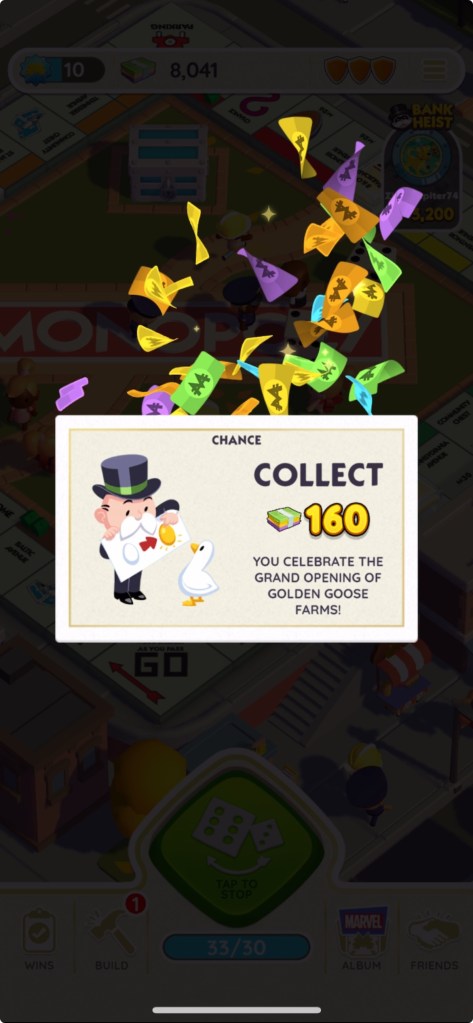

Luxury tax: Luxury taxes require the player to pay cash as a luxury tax. A mini sink of cash is established here.

Jail: When in jail, you’re required to spend rolls to attempt an escape. To successfully escape, you have 3 chances to roll doubles (two dice with the same face values). During my first hour of playing, I never failed to roll a double to get out of jail. The next day, however, I failed to roll doubles twice and was forced to pay bail. Like the luxury tax, this serves as another cash sink.


Moving On Up
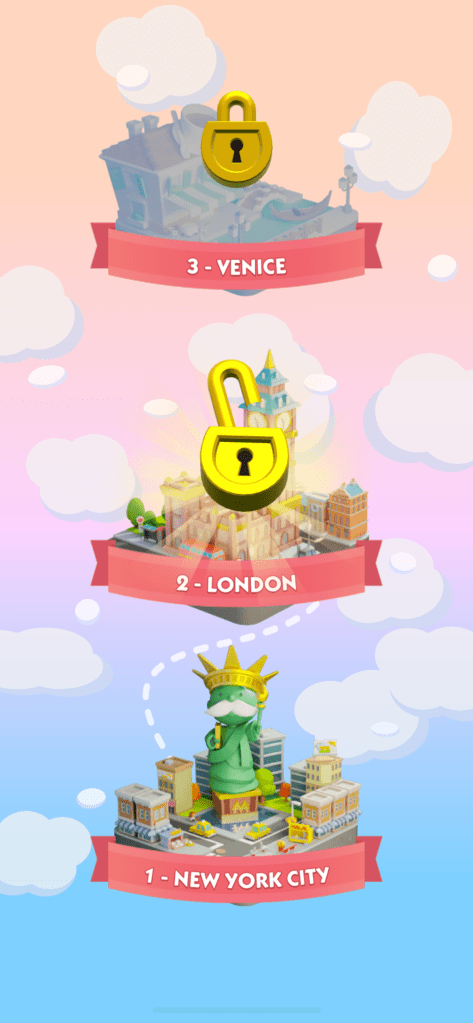
Once you’ve gotten used to most of the core mechanics, you’ll complete all the buildings in New York. Upon completing all buildings in New York, you progress to London, which introduces us to the core loop of the game and a new board. Completing a board can give players an assortment of cash, rolls, and/or tickets.
Core Game Loop & Meta Loop
Core Game Loop
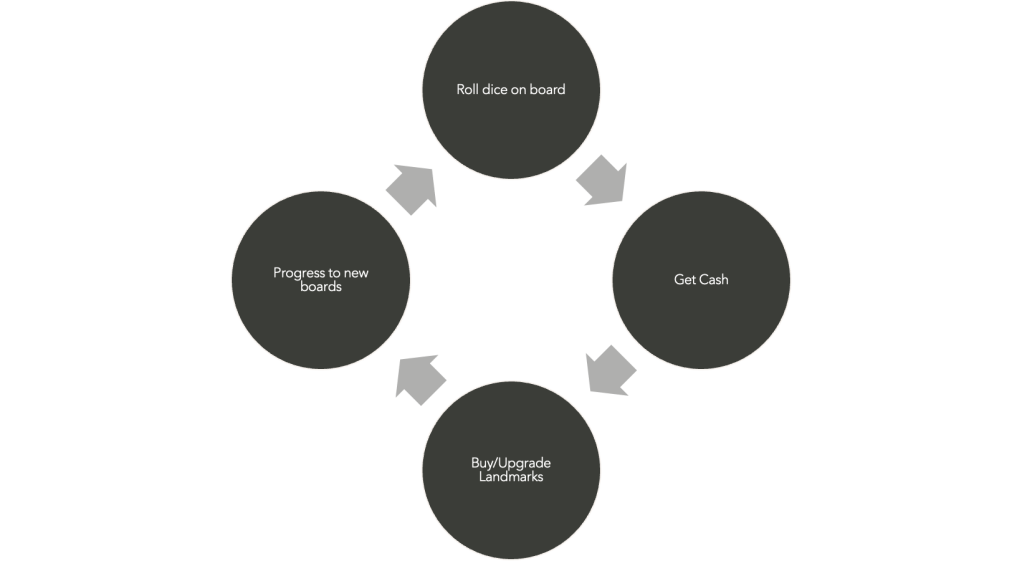
The core game loop of the game is fairly straightforward – rolling dice on the board is the core mechanism of interacting with gameplay. Various objectives like landing on rental squares, rolling doubles, earning rewards via LTM’s and more earn you cash which allows you to buy and upgrade landmarks. From there, you progress to a new board.
Meta Game Loop
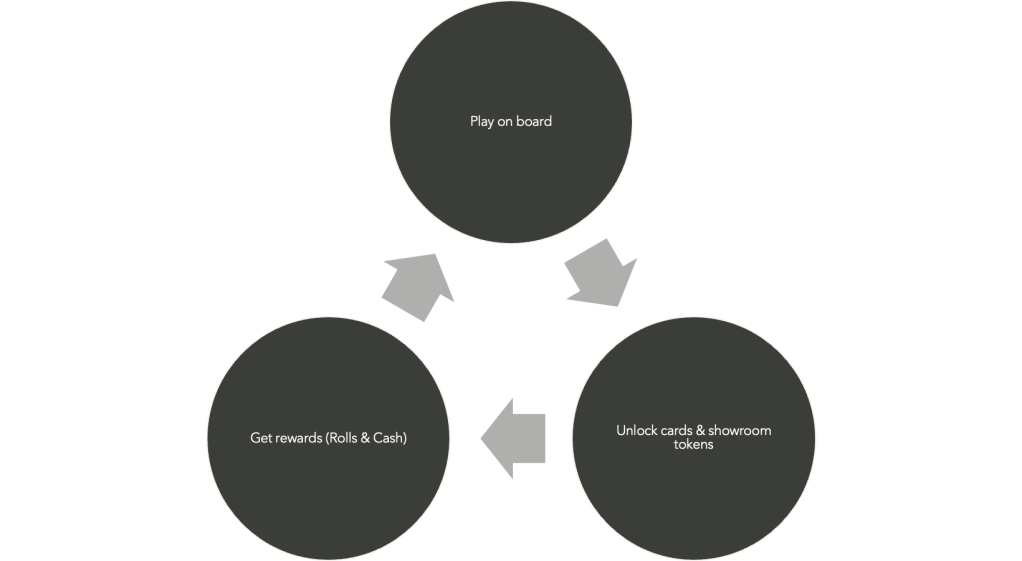
Monopoly Go! Offers a pretty solid metagame systems – stickers, and tokens. Upon collecting a full album of tickets, players get the opportunity to gain a huge reward. For example, completing the Avengers Monopoly album gets you 500 rolls, and 191,000 in cash. It’s a huge incentive, especially compared to bank heists and shutdowns. In case you’re struggling to complete the card collection, you can request stickers from friends. In my eyes, the meta loop is fairly simple, and it provides just enough without disrupting my attention.
Economy
Monopoly Go has a stationary shop that only consists of rolls, and cash. As would be expected, your value per roll or value per unit of monopoly cash increases as you pay more. A nominal increase in value, but the increase in playtime or upgradeable buildings is quite vast.

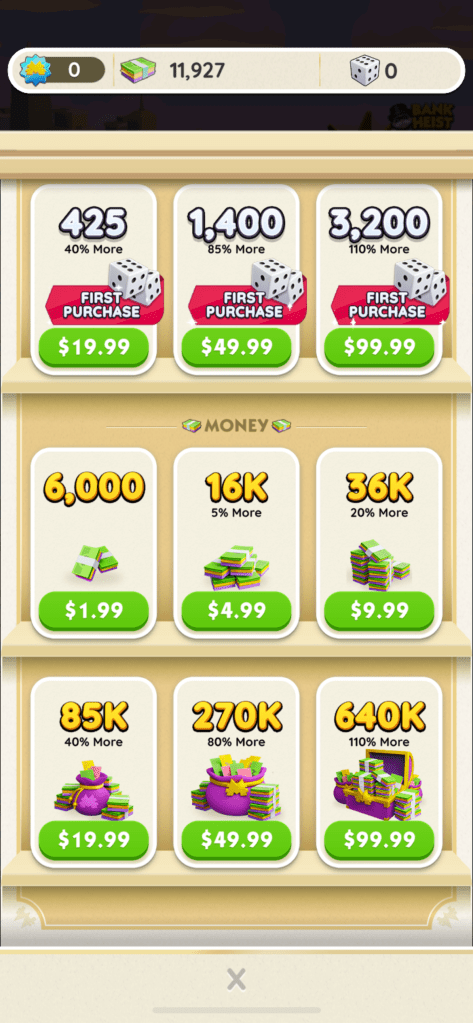

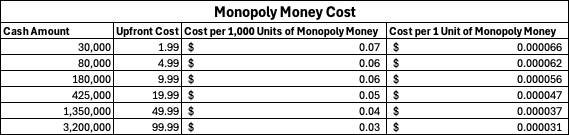
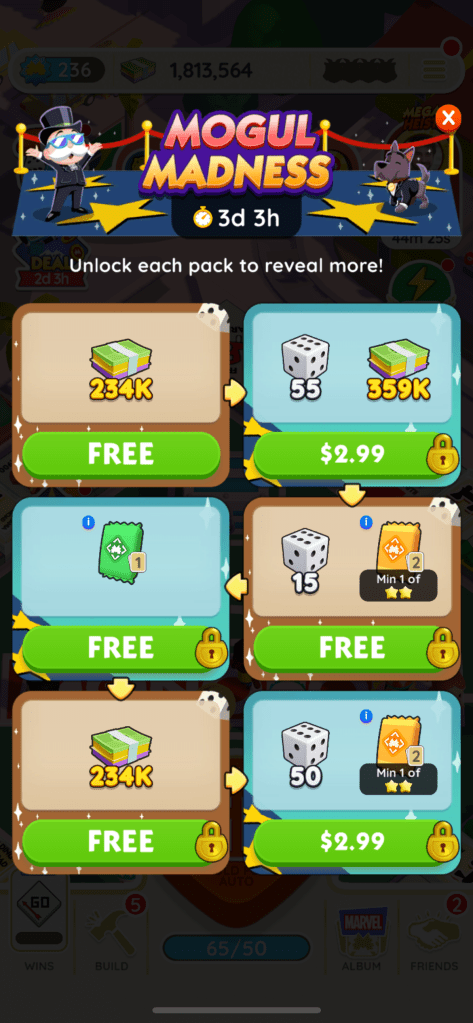
The game runs a bunch of bundles and lower cost rolls to create added value. For example, I’ve ran out of rolls while playing and had the option to get 95 rolls for the cost of 80 rolls. There’s also a special track that bundles cards, rolls, and cash:
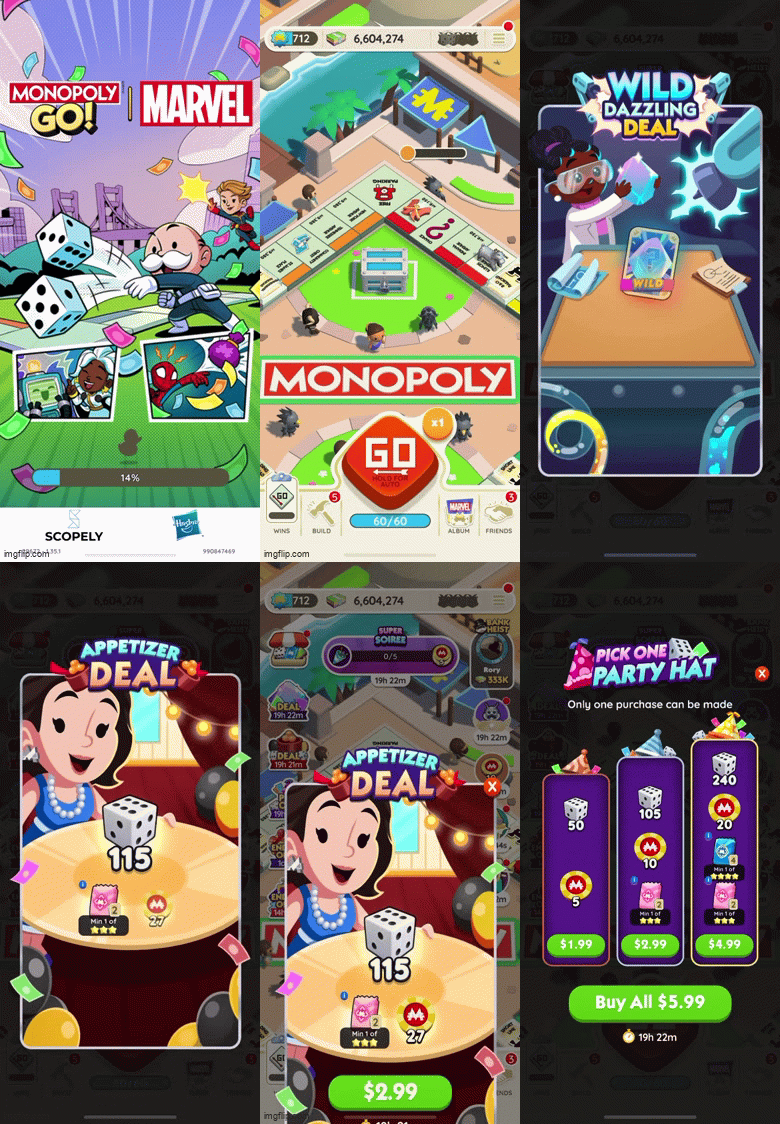
Monopoly Go effectively monetizes through various methods without significantly detracting from the gameplay. While not all displayed in the gif below, they use tools like decoy offers, and endless offers, extra coin/extra spin offers (see Mikel Kopelvich’s article – it’s a great article that breaks down additional monetization strategies used by social-casino games).
What Monopoly Go does Great
Since its launch in April 2023, Monopoly Go has made well over $3 billion in revenue, and it doesn’t show many signs of slowing. It was a major driver of the genre in 2023, helping improve Casino revenues by 18% (https://gameworldobserver.com/2024/04/08/state-of-mobile-gaming-2024-sensor-tower-report).
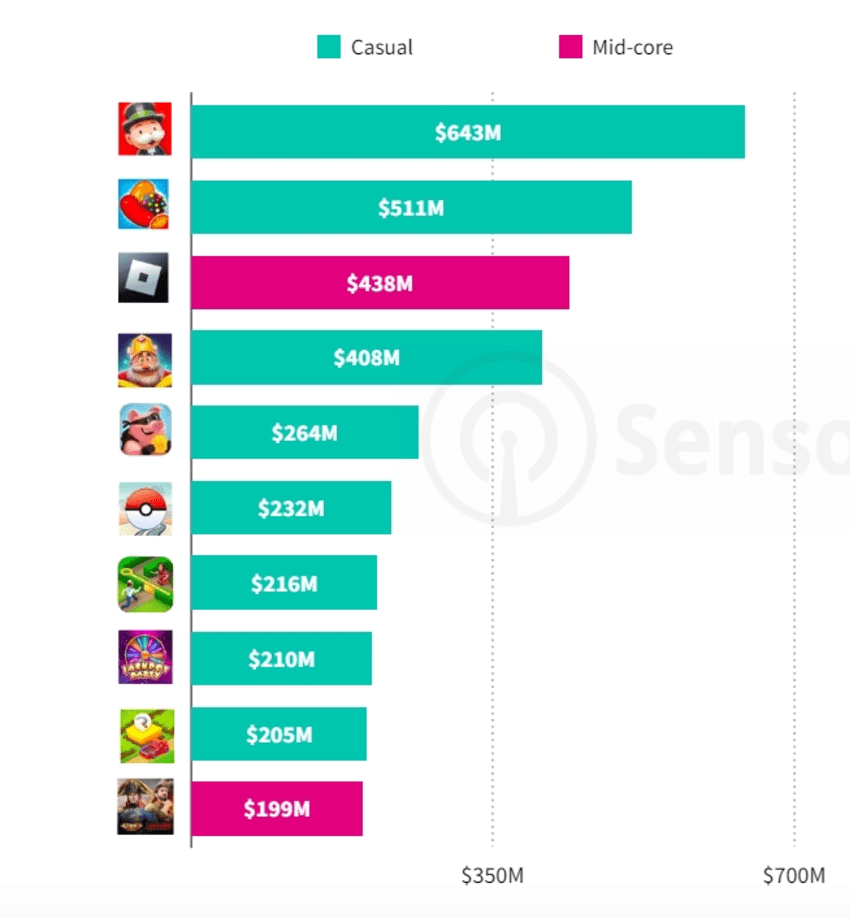
Monopoly Go’s success is no mistake, and it will absolutely continue to improve. Here’s some additional reasons why I think Monopoly Go truly stands out:
When you lose, you still win
In traditional Monopoly, if you land in Jail, you must exit on your next turn by 1) using a “Get Out of Jail Free” card if you have (or can buy) one; or 2) rolling doubles; or 3) paying $50. Unlike the standard rules, you may try to roll doubles and, failing to do so, pay the $50 on the same turn (Hasbro Rules).
Monopoly Go creates opportunities out of rough situations, in lots of cases. In Monopoly Go, if you successfully roll doubles, you get awarded with additional rolls. If you land on a luxury tax box, you can get awarded with LTM currency that can net you rewards in cash, rolls, cards, and more. In a way, they tap into our deep-seated psychological needs for hope and control – transforming setbacks into opportunities for success.

Buddy-Buddy (The Socials)
Games like Words with Friends rely on friendship as a key indicator of retention. Let’s say you and your best friend play Words with Friends together. If your best friend feels like quitting, you can convince your best friend to keep playing and they are SIGNIFICANTLY more likely to continue playing. I think Monopoly Go takes a page from Words with Friends in terms of its socials. Let’s talk about the community chest.
The objective for the Community Chest minigame is pretty simple. You tap the “Start” button to remove friends from the board and land on the Community Chest key. Once you open the chest, you will see a board with nine of your friends.
The more friends you remove from the board, the higher the jackpot. If you’re able to remove all nine friends before collecting the key, all the money will be multiplied by x50 and you’ll win a Purple Sticker Pack (The Gamer).
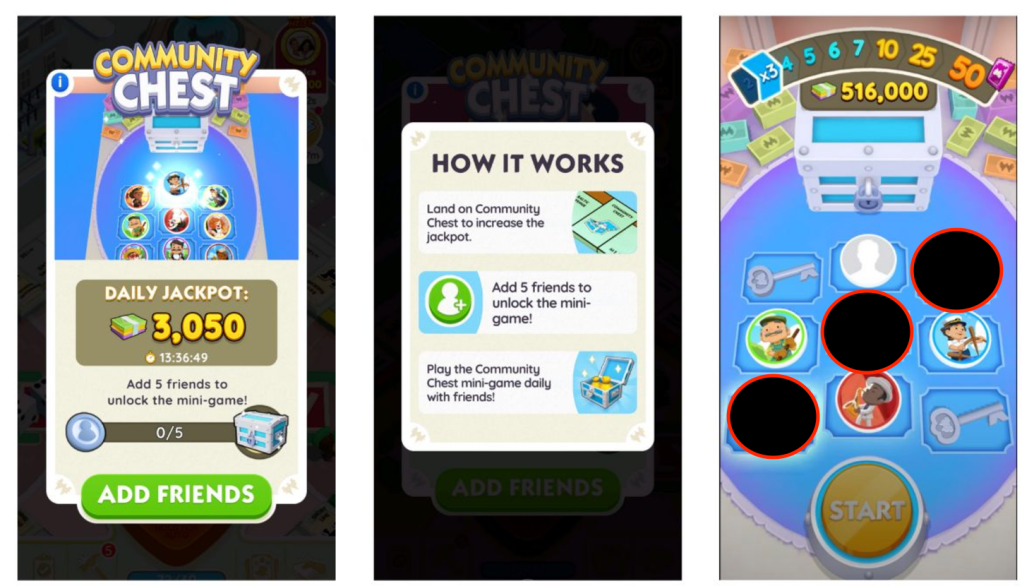
Friends are also incredibly useful for Monopoly Go. Not only can you get extra rolls for adding friends via Facebook, and your phone contacts, but you can trade cards with friends to complete a deck. This is very valuable because you can get hundreds of rolls and millions worth of cash.
Limited Time Modes
This is the longest section of what Monopoly Go does great, so here’s a quick TLDR if you want to skim and keep moving:
Monopoly Go stands out with its engaging limited-time modes (LTMs) that offer players unique gameplay experiences and substantial rewards like rolls, cash, and cards, all while extending the core game loop in a positive manner. These LTMs provide a great boon in boosting retention, engagement, and monetization for Scopely.
For me, the key differentiator and the strongest part of Monopoly Go as an offering is its limited time modes – players can earn massive rewards. I’ve received hundreds of rolls as a result of playing limited time modes, and millions of cash in monopoly money. Plus, lots of them are fun – they extend the game loop by offering cool, new game modes every couple of days.
Monopoly Go doesn’t offer a traditional battle pass. While players progress through net worth, it does not require a purchase, and it does not reset. It’s more akin to leveling a character in an RPG. However, what Monopoly Go does incredibly well is offering a myriad of limited time modes.
Monopoly Go seems to run a limited time events once or twice per week – for most titles, this seems to be a major differentiator. Some are more skill/guess focused – for example, pickaxing the ground to uncover artifacts to get new cards, rolls, or cash. Others are much closer to casino royale games.
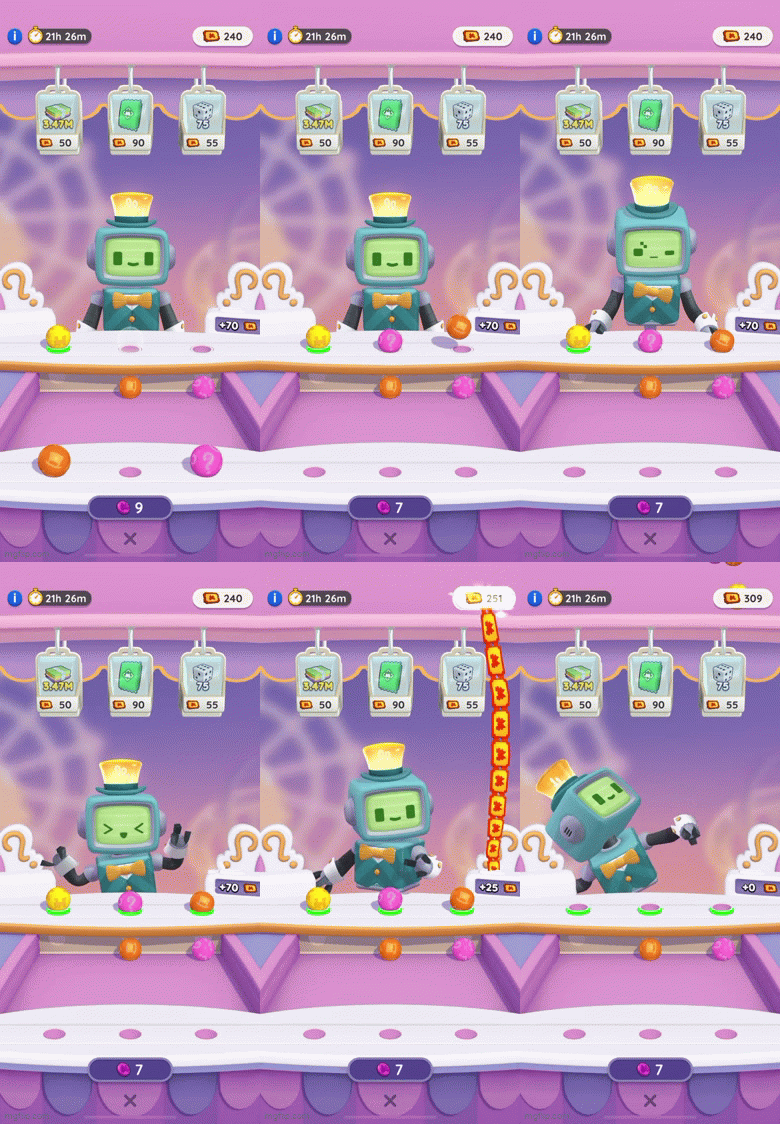
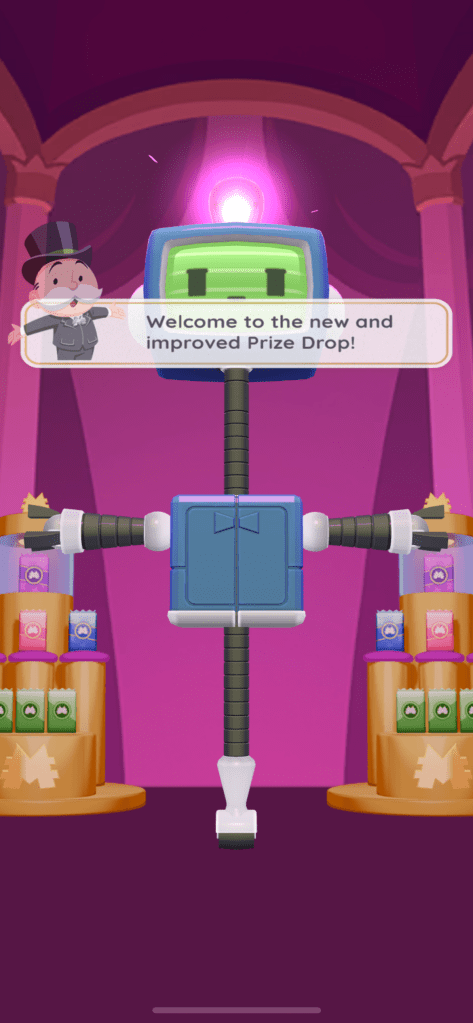
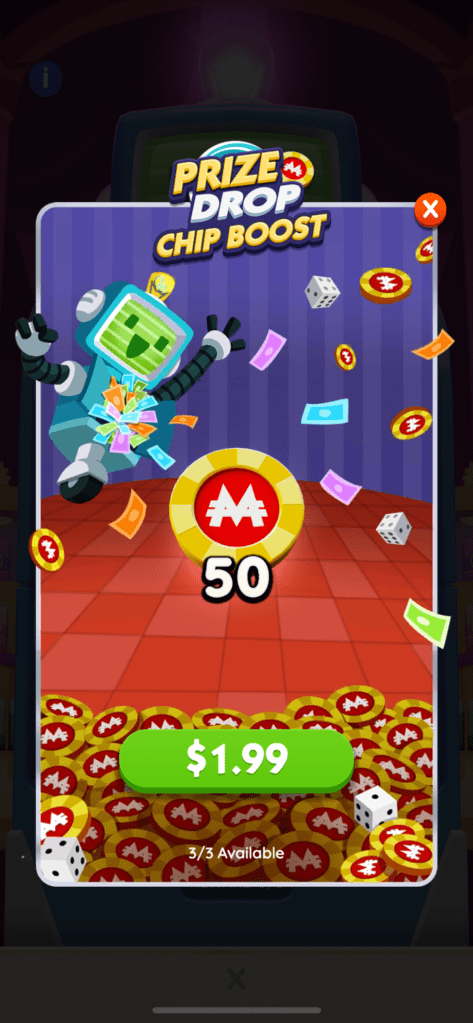
As an example, there’s a prize drop game – it is similar to the arcade game of coin drops. In this limited mode, each tunnel nets you a reward of points. Points then brings you closer towards the larger reward of new cards, and as you progress, you get higher tiered cards which are needed to complete decks. You have a limited number of tokens to drop, and you have the option to use your multiplier to increase the rewards you receive.

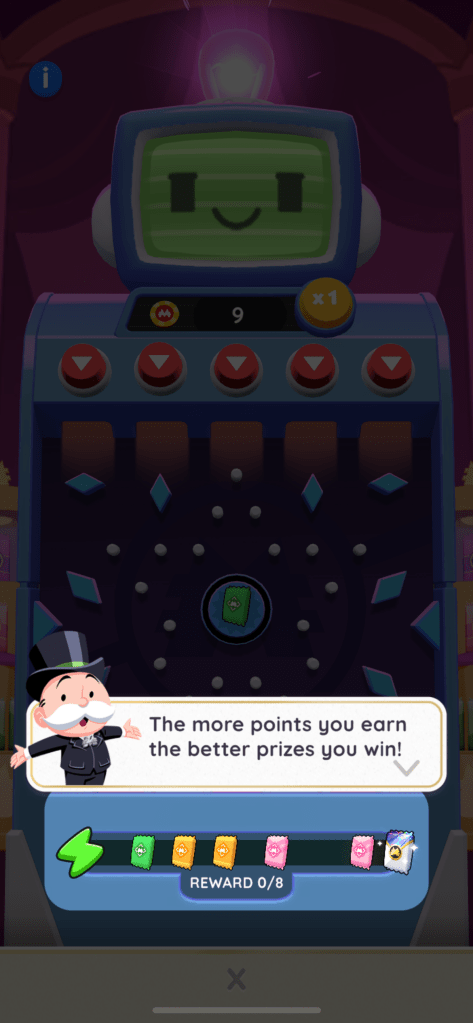
What’s more, it is loosely tied to the core loop of the game. Ultimately, the only thing I need to invest is a little more time. This is great because players are rewarded with bigger payoffs for the time they spend. Monopoly Go and Scopely are able to benefit because they get higher levels of retention and can monetize a bit off their LTM’s.
Haptic Feedback
While it is an incredibly minor feature, this is the type of thing that can truly elevate games. This is a feature that could have easily been excluded from their production pipeline or deemed less important than other features. The haptic feedback feels immersive, providing the sensation of dice hitting the board, or a distinct tapping sensation when you press the roll button, or the feeling of the coin piece hitting the shiny bumper and vibrating and lighting up my iPhone. While many games utilize haptic feedback, this feature stands out as a key differentiator, highlighting another reason for its success.
Recommendations
- Queueing
Yes! I just totally lauded how important Monopoly Go’s socials and friend features are for the to the game. However, I think queueing as a feature would be great. Friends aren’t always available, and friends aren’t always going to want to play Monopoly Go with you. In the case they are not, I think a queueing feature would be great.
Pros:
- Caters to solo-oriented players
- More immediate gratification
- Likely increased session length (less time players wait for friends to respond to texts or invites)
Cons:
- Possible disruption of friend usefulness
- Could harm retention for cohorts with lots of friends
Rollout:
I’d roll this out as a limited time mode. Using the chest mode as an example, we’d have two modes available – a friend chest and a queue chest; the friend chest game would remain the same, but the queue chest would have slightly lower rewards – let’s say 30 or 40% of the max that could be received through playing with friends. This way, those that play the community chest with friends don’t feel disincentivized for not playing the queuing mode.
I’d closely monitor KPI’s like average session length and average number of sessions per player. This is a heavy engagement feature, so I’d like to watch those numbers go up (ideally).
- Marketplace to Trade Cards
My theory is that adding a marketplace to trade cards would create an additional sink for players to drop cash into (Think WoW’s auction house). It could provide players with another way to develop short-term and long-term goals with the game and give them another way to think about their traditional playthrough.
Pros:
- Additional way for players to engage and get more cards
- Added engagement opportunities with marketplace
Cons:
- Could overinflate growth of cards and/or cash
- Cards could provide a disproportionate amount of awards, and too much cash could dampen progression cadence
Rollout:
Lots of playtesting and data would be crucial to put this out successfully. The facilitation of a cap on cash to be earned would also be a useful plan to combat against players pricing common cards for exorbitant amounts of cash.
On a similar note, you can set a ceiling on the number of cards purchased in a day. For example, players can buy up to 2 cards within a given day, to ensure they aren’t gathering hundreds of cards and unlocking hundreds of decks per day.
Monitoring engagement and transactions within the marketplace, and transactions on the shop would be useful. If successful, I would theorize that players would have longer session lengths, they would engage with the marketplace, and a possible increase in ARPDAU could occur due to players wanting to purchase a specific card that’s in the marketplace.
- Gift friends rolls/cash
I think the idea of sending a stimulus pack would be pretty awesome – whether it be in the form of rolls or cash. You could call on friends during a lucrative LTM for extra rolls to cash out more on your board or just call on friends if you want to play more.
Pros:
- Additional way for players to engage and get more cards
- Added engagement opportunities with marketplace
Cons:
- Higher net worth players effectively ‘boosting’ their lower net worth friends really quickly
- Cards could provide a disproportionate amount of awards, and too much cash could dampen progression cadence
Rollout:
I don’t think rolls would be as much as a problem as cash could pose. Three ways to mitigate are:
Mirroring Pokémon Go and maxing the number of gifts to sending one gift per day
Limiting rolls to 10 or 20 extra rolls
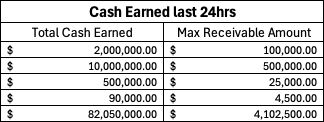
Setting a cap at 5% of highest earned cash for a player’s account in the last 24hrs.
This is definitely back of the envelope math to roughly visualize the idea. It would take tuning and testing to refine the right amount to gift players (See screenshot below):
I’d like to see the average number of cash and rolls sent/received for active players. I’d also like to see the affect it has on retention – players who rely on and play with one another (remember Words with Friends!) are traditionally more likely to retain on a higher clip.
Conclusion
Monopoly Go shows no signs of slowing its successes, and I think Scopely is in a great position to capitalize of Monopoly Go’s successes and apply them across its portfolio. It excels in creating an engaging and monetizable experiences through its innovative core and meta loops, with incredible LTMs, and strong social mechanics. Combined with intuitive design choices like haptic feedback and its adorable animated cutscenes sets it apart in the wildly competitive mobile gaming landscape.
While the game already caters to diverse player motivations, introducing features like player queuing, a card marketplace, and the ability to gift rolls or cash could make it a stronger game. However, these gameplay changes should be carefully implemented and thoroughly tested to preserve balance and satisfaction within the game.
 Gaming stuff
Leave a comment