Fortnite is known for its unique ‘building’ feature, which changed the shooter game genre. As players got better, winning became tougher, so Fortnite introduced a ‘Zero Build’ mode to quite literally level out the playing field. On the other hand, Google’s Stadia, a cloud gaming offering, failed due to underinvestment, a lack of compelling games, and not understanding the gaming market.
A little bit about Fortnite
Fortnite is a video game by Epic Games that has garnered unbelievable growth in the past decade. Epic Games reported in 2020 that there were more than 350 million registered users, and that number grew to 400 million in 2021[1], and that number is expected to be even higher in 2023. One of the reasons for its polarizing growth and acclaim is due to its unique mechanic of ‘building’. Fortnite falls under the ‘shooter’ genre, and typical shooters incorporate cover and strafing mechanics, enabling players to use various buildings and structures as protection. However, Fortnite flipped this concept on its head by introducing a novel feature: players could construct their own cover. This design aspect alone distinguished themselves under the shooter genre with polarizing subgenre elements. At the time of Fortnite’s release, it was even more important as the shooter genre was frequently criticized for repetitive gameplay mechanics.
However, Fortnite found a problem with its unique building’s unique mechanic. As player skill levels increased, the entry level for casual Fortnite matches skyrocketed. Winning a game required significant dedication to master the art of building. Fortnite needed to innovate, and they found a magnificent solution in the form of a ‘Zero Build’ game mode.
Google’s Stadia!
Stadia is a cloud gaming service that was created and operated by Google. In a perfect world, users have access to internet, and can play from a library of games owned by Stadia on a streaming basis; think Netflix or Hulu, but for games. In comparison, in most gaming business models, players get games through digital downloads from platforms such as the Android store or the PlayStation market. Alternatively, they can take the ‘old-fashioned’ approach, and purchase the physical copy from a local retailer like BestBuy or GameStop. Stadia failed and Google chose to shut it down, which I believe is due to a lack of content, lack of investment into Stadia, and lack of customer understanding.
Why did No-Build succeed?
Removal of Barriers to entry
Upon Fortnite’s release and during its infancy, players were not as skilled, and the skill ceiling was quite low. However, this changed within a few years of the game’s release. A core mechanic of winning in Fortnite’s original build mode was gathering resources throughout the entire game and managing resources upon engaging with another player. For new players, this is simply a barrier too high to understand; even for experienced players, this is an incredibly taxing task. On the other hand, Zero-Build immediately drops those barriers – players can drop in and get into the action right away. This also has an impact for streamers and content creators who need compelling content to attract viewers. What’s more, both competitive and casual players alike need high internet speed access to adequately compete in Fortnite’s build mode. Depending on location and centrality to servers, it’s simply not possible. Fortnite’s strongest servers exist in the East Coast closest to its headquarters in North Carolina. Without high internet access and low ping, which is essentially a server response, it serves as a massive barrier for players who want to engage in competitive gameplay, especially important for streamers and content creators. Finally, in contrast to the ‘Zero Build’ mode where players can drop into exciting areas and dive straight into action, the initial five minutes of a Fortnite streamer’s gameplay in build mode often involve starting in a seemingly ‘boring’ area to collect materials and engage in a ‘less-fun’ format because they simply cannot compete with players that have incredibly high internet connections.
Introduced as a Limited Time Mode (LTM)
Seemingly out of the blue, Fortnite temporarily removed the building mechanic entirely. Its core player base was surprised, and some key members of the community were upset. However, Fortnite saw new players and players that previously left, drop in and connect with the limited time mode of zero building. Epic Games made a remarkable decision by introducing a time-limited offer; ordinarily, its temporary game modes endure for several weeks to a month, and their return is uncertain. Epic Games capitalized on this limited time offer by creating a sense of urgency and fostering scarcity, offering a new value proposition, and arguably most importantly, testing a new service. Popular streamers were clamoring for the game to become a permanent mode, something I imagine Epic planned for based off the data it gathered. While Epic Games keeps its data very private, it can be inferred that the company was able to collect invaluable data and make a strategic decision, guided by undeniable concrete data, to add zero build as a permanent game mode.
Innovation
The gaming industry is constantly evolving as player preferences shift every day. Games are competing for time and attention of people, and to maintain their status as a leading video game, Epic Games needed to adapt to keep gameplay fresh and engaging. As such, Fortnite has always been an innovator in this category; taking hints like perks from Call of Duty and taking a note from Apex Legend’s movement design – something that was seamlessly integrated into Fortnite’s Zero Build mode. In addition to no building, players could now slide, mantle, and sprint, reintroducing a new high-action and momentous style of gameplay (Ex 1).
Why did Stadia fail?
Lack of Stadia Investment
To this day, Google is arguably the best technology company in the world, but it failed in pushing exabytes of data for Stadia. Google developed warehouse-scale computers to push this data, but the needs of games compared to services are vastly different as gamers need the best of server ping to be able to perform at an adequate level. Stadia’s performance was wildly hindered by the sluggishness of its servers. To put it into perspective, upon opening games, players can change their settings based on their internet latency. For those with the fastest internet services, they can play on Ultra or High settings, middle of the road gets medium, and slower internet speeds run on lower settings[2]. Regardless of internet speed, in most cases, the highest setting players could play a primarily live service games were medium. To add insult to injury, Stadia claimed it ran at 4K resolution, however, it primarily ran at 1080p.
Gamers also find latency of incredible importance; again, to play a game successfully, players need to have a low level of gaming latency. Even though Google should arguably have more servers than almost any company in the world, Stadia’s latency was typically below average. FPS is a measure of how many individual images or frames a video game, animation, or video playback displays in one second. Higher FPS values result in smoother and more fluid motion, while lower FPS can lead to choppier and less realistic visuals – this is critical for delivering a positive experience in gaming. GeForce Now, a cloud gaming service offered by Nvidia, offers 120 frames per second (FPS); something Stadia couldn’t even offer. In some cases, it even lost out to a previous generation, seven-year-old console in terms of FPS and performance (Ex 2).
Lack of Content
One of the driving reasons people choose to “pledge loyalty” to a specific console is typically due to console exclusives – what’s more, consoles rarely release without an exclusive. In the past, titles like Halo and Gears of War drove consumers to purchase the Xbox, whereas now, the scales have tipped in PlayStation’s favor, with titles like God of War and Marvel’s Spiderman capturing lots of attention. Stadia had no such titles; in fact, I could not name a flagship title off the top of my head, which is rare as I consider myself an avid gamer. Stadia offered titles like Get Packed, and Gylt which were relatively high rated, but they did not hit critical mass as needed. Plus, there were developmental flaws with the game and Stadia’s high internet cost[3]. Colossal budgets are allocated to console exclusives, with some AAA companies investing up to $250 million, requiring extensive teams and substantial marketing efforts to promote the game effectively[4]; something Stadia was either unaware of, or simply did not do.
Lack of Customer Understanding
The gaming industry is incredibly challenging. It demands long hours, and it generally yields lower profit margins. To be successful, substantial investments in personnel and technology are necessary just to break even. One year after Stadia was launched, Stadia Games & Entertainment which was the division charged with making exclusive first party games and bringing in 3rd party titles, was disbanded. With a pivot to a ‘technology’ platform, as stated by Stadia VP Phil Harrison, it simply showed that Google lost a sense of strategic focus in Stadia. This lack of strategic focus ultimately failed Stadia. Google aimed to provide an accessible entry point into gaming by offering lower prices for the Stadia console. However, platforms like Nvidia’s GeForce Now and Microsoft’s Xbox Game Pass simply offered more and superior options for players using established technologies like the Xbox or a PC. Stadia could not formulate a compelling value proposition to persuade these players to switch, thus missing a crucial aspect of audience analysis and critical mass.
Fortnite has effectively leveraged the investments made by Epic Games over the years. This has resulted in a wealth of content and a profound understanding of its player base.
Investment
Fortnite continued to scale and adapt to changing player preferences. As a live service game, it expanded into elements that were typically video game agnostic, investing heavily into data science and machine learning, artificial intelligence, pop culture, product marketing, and so much more. Zero-build addressed multiple gaps, and shrunk barriers. In comparison to Stadia, players needed incredibly low latency to have what most would consider a ‘passable’ gaming experience.
Content
Fortnite continues to release new content on a regular basis. In addition, if players become bored of official Epic Games content, they can go make their own game mode within the ‘Creative’. ‘Creative’ allows players can to create and share game modes within Fortnite. They can take it a step further by using Fortnite’s Unreal Engine editor, creating essentially a brand-new game using the mechanics of Fortnite. Stadia offered no type of compelling content; one of its highest console exclusives rated games was Gylt, which was rated a lackluster 68% when it was initially released on Stadia.
Misunderstanding Gaming Market
Fortnite has created limited time modes to essentially serve as an incubator; game modes that are successful and received well can land under a permanent playlist or it could be shelved and used as part of its creative mode. What’s more, it was able to drive tons of decisions on advanced algorithms and data. Google’s failure to understand the gaming industry’s demands and dynamics, along with Stadia’s high latency, and the premature disbandment of Stadia’s Games and Entertainment division, set it on a path towards failure.
Hindsight is always 20-20, but Stadia could have done a handful of things a little better; strategic prioritization, opportunity prioritization, and a more detailed customer analysis.
Strategic Prioritziation
While Stadia’s opportunity identification was good as there was a desire for Cloud-based gaming, Google was not ready to deliver. During opportunity identification, strategic guidelines to frame the entire new product development process should be available, and a product innovation charter. For example, if Stadia included clearer metrics that were indicative of its failure, it would have been able to shelve the product sooner instead of hemorrhaging so much money.
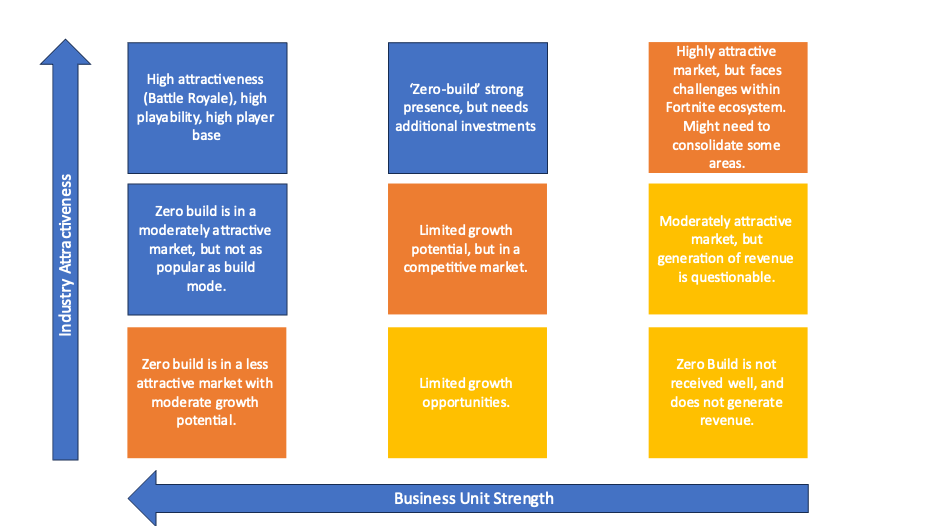
Prioritize Opportunities (Ex 3)
One thing Stadia failed to do was prioritize its opportunities based on the strength of the business. Stadia tried to be too many things at once; both a console creator, and a game developer, two very distinct and difficult opportunities. Both Microsoft and PlayStation have an entire, individual business entities dedicated to the development of Xbox and PlayStation. It’s not limited to just content curation, but community management, branding partnership, technological development, and more. In comparison, Google truly lacked a strategic vision, and failed to capitalize on its technological advantages. For example, to fix its high latency issues, Google could have deployed Stadia-only servers to support its latency issues or formulated a production division to oversee external production partnerships with gaming development companies.
Customer Analysis & Trends
Fortnite clearly understood its customer needs. The high skill gap and high cost of internet for its build mode caused major pain points for players. To drop these barriers, its addition of zero-build created a much friendlier version of Fortnite, and coupled it with a fun, action packed game mode. Fortnite was able to match changing customer segments and unmet needs. Stadia never understood its value proposition; was it simply an affordable offering, was it a pioneer in the cloud gaming audience, was it a compelling new service with loads of content? Ultimately, Stadia never understood its respective target market.
Exhibits
Ex 1: Movement Design

Ex 2: Frame rate comparisons
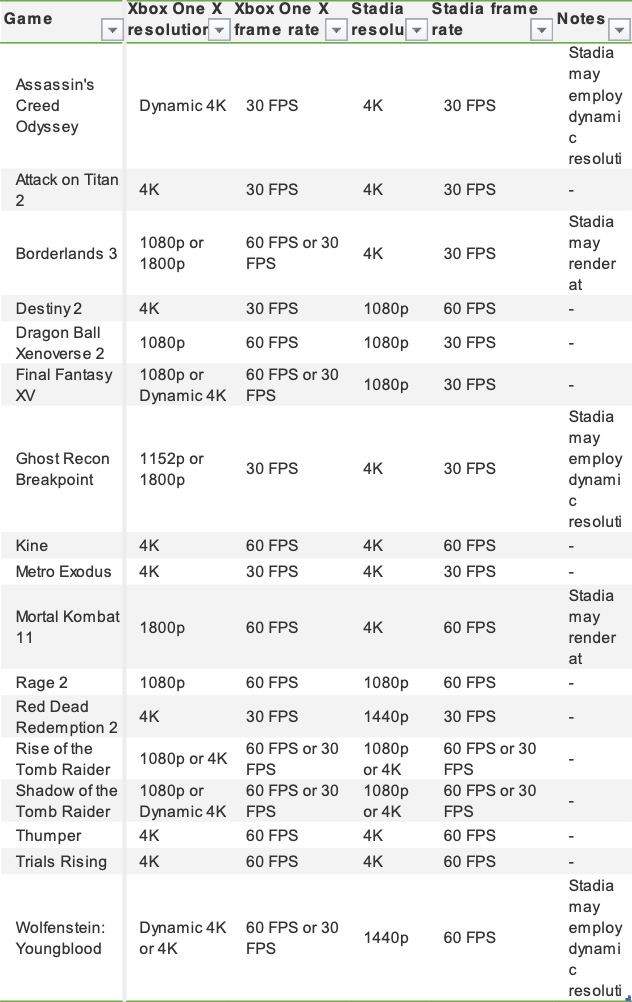
Source: Google Stadia vs. Xbox One X game resolution and frame rate comparison | Windows Central
Ex 3: GE – McKinsey Matrix for Zero Build
[1] Retrieved from How many people play Fortnite? Player count in 2023 – Dexerto
[2] Retrieved from Google Stadia Is a Failure. The Company Should Kill It | WIRED
[3] Retrieved from Stadia Exclusive Games That Deserve A Second Chance on Other Platforms (gamerant.com)
[4] Retrieved from What is the Average Cost of Game Development? – Guru Blog
 Gaming stuff
Leave a comment